

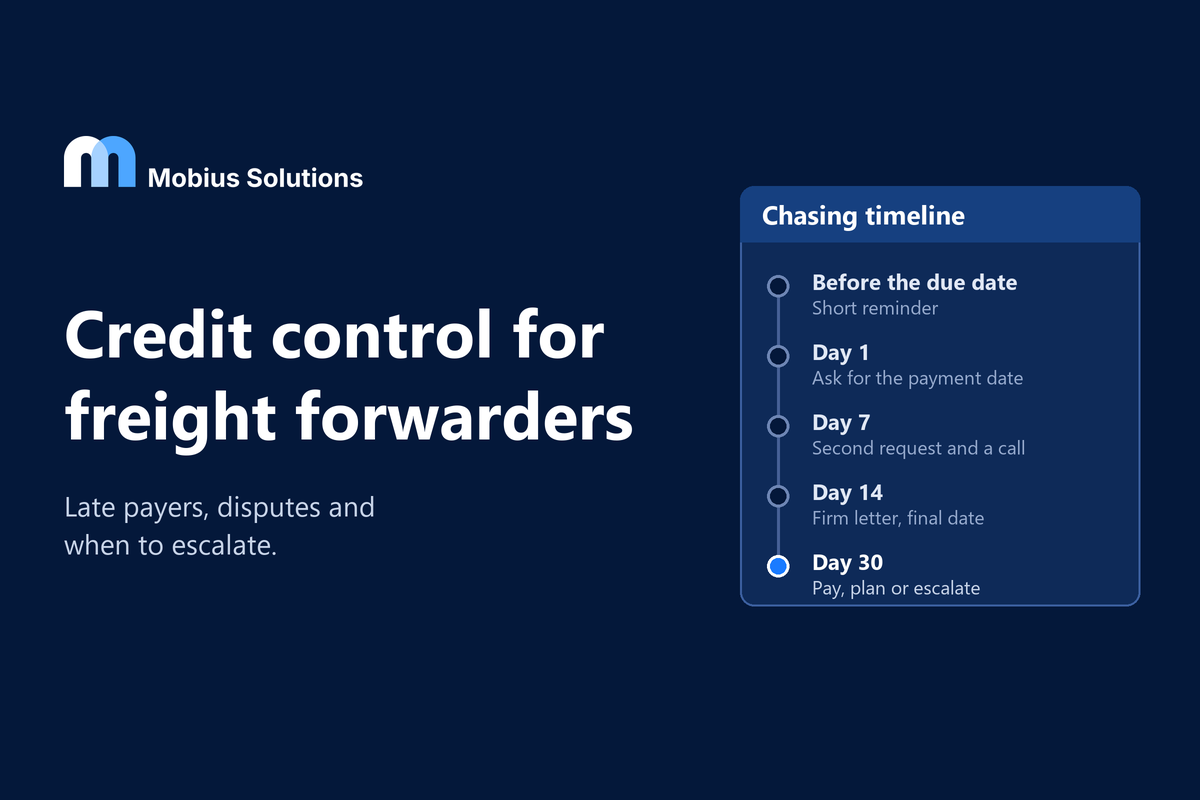
Chasing timeline for an overdue freight invoice, from reminder to escalation
A freight forwarder pays the carrier, the terminal and the haulier first, then waits to be paid by the customer. Margins are thin and the money is already out of the door. One slow payer can tie up more cash than the profit on a month of that customer’s shipments.
This note sets out how we would run credit control in a forwarding business: what to do before the shipment, how to chase, how to handle disputes, and when to hand a file to someone else.
Why forwarders get paid late
Late payment in forwarding often comes from one of four places:
A dispute about part of the invoice. Demurrage, detention, storage, surcharges and amended bills of lading are common sources. The customer pays nothing while one line is argued.
The customer’s own cash problem. They pass the delay on to you because you are easier to delay than their own bank.
Unclear terms. Payment days run from invoice date, delivery date or something else, and nobody can say which.
A weak first check. The company was never looked at before credit was given.
Each needs a different response. Chasing harder fixes none of them.
Before the shipment
Check who you are dealing with. Confirm the company exists, who owns it and whether it has a record of late payment or disputes. A short due diligence report can cost far less than writing off an unpaid invoice. See our note on company due diligence before extending trade credit.
Put the terms in writing. Payment days, what they run from, and how disputes and extra charges are notified. Agree this before the first booking, not after the first problem.
Set a credit limit per customer. Decide the most you will have outstanding, and who can approve more.
Quote extra charges early. Tell the customer when demurrage or detention might apply, before it does.
Check your own terms, including whether they give you a right to hold goods until you are paid, and what notice you must give before you act on it. Take advice before holding or selling a customer’s goods.
A simple chasing timeline
Adjust the days to your terms, but keep a fixed routine, so no invoice is forgotten and no customer is surprised.
Before the due date: a short reminder with the invoice, the due date and the paying details.
Day 1 after due: a polite note asking for the payment date, or for the reason if there is a problem.
Day 7: a second written request and a phone call. Ask for a named person and a date.
Day 14: a firm letter that sets a final date and says what happens next. Mention late payment interest only if your terms or the law that applies allow it, and do not threaten legal action unless you intend to take it and it is available where the debtor is. See our note on late payment interest.
Day 30: a decision. Pay, agree a plan in writing, or escalate.
Keep every contact on record: who, when, what was promised. If a payment plan is agreed, put it in writing and keep to it. Do not accept part payment without confirming in writing that the rest is still due.
Handling disputes
Split the invoice. Ask the customer to pay the undisputed part now, and to state the disputed lines in writing.
Ask for the specific complaint. “Wrong” is not an answer. Which line, and why?
Answer with documents. Bill of lading, delivery proof, carrier invoices, emails agreeing the charge.
Set a short review date and keep to it.
A dispute about one line should not hold up the rest of the invoice. If the customer will not pay the undisputed part, treat it as a payment problem, not a dispute.
When to escalate
Consider handing the file on when:
the customer has not replied to two written requests;
a promised payment date has passed twice;
there are signs of trouble (closed offices, returned mail, other suppliers complaining);
the amount is large enough that continuing in-house costs more time than it should;
the debtor is in another country and you do not know the local routes.
Before you escalate, collect the invoice, the contract or booking confirmation, proof of delivery, the correspondence and the debtor’s full legal name, registered address and company number. A clean file saves days.
For cross-border debts, escalation is about knowing who can act where. We cover the UK and Europe directly, and work through partners in China, the Middle East and the Americas. We recover commercial (B2B) debts, on a no win, no fee basis for aged debt, with the terms confirmed in writing before we start. Legal letters, site visits and disbursements are quoted separately.
What we can do
If your own team has too much on, we can run credit control for you: invoice delivery, reminders and chasing under your brand. If an invoice is already old, we can look at it first. Send it through our Free Claim Assessment. It is free, confidential and without obligation. We guarantee our effort and method, not the outcome.
This note is general information, not legal advice. Check your own terms and the law that applies to your contract.
About the author
Khalil Ibrahim is Head of Collections & Recoveries at Mobius Solutions, with 17+ years in cross-border debt resolution.
