

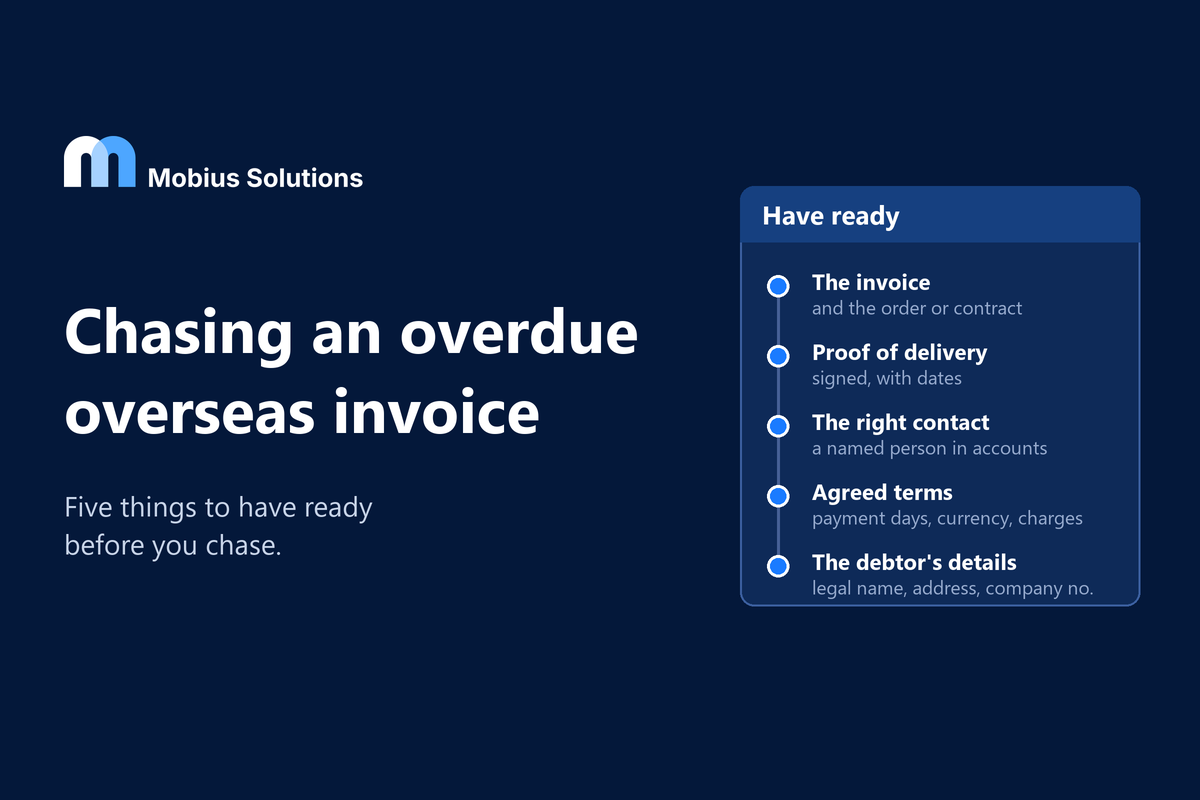
Five things to have ready before you chase an overseas invoice
A late invoice is irritating at home. Overseas, it is harder: a different time zone, a different language, a bank that charges for every transfer, and a customer you may never have met. This note sets out how we would handle it, from before the goods leave to the point where it is time to ask for local help.
Why overseas invoices go unpaid
The causes are usually the ones you see at home, with extra friction on top:
The invoice goes to the wrong person, or sits in an inbox nobody checks.
The customer disputes part of it, and nobody says so in writing.
The customer cannot pay on time, for cash flow reasons or because payments abroad are slow to approve.
Bank charges, currency conversion or, in some countries, local tax deductions mean the amount that arrives is less than the amount you invoiced.
Each needs a different reply. Reminders alone solve only the first.
Before you ship
Check the company exists, who owns it, whether it has a payment record, and whether it or its owners appear on sanctions lists. See our note on company due diligence before trade credit.
Agree the terms in writing: payment days, the invoice currency, who covers bank and conversion charges, and what happens if there is a dispute.
Send the invoice to a named person in accounts payable, not a general address, and ask them to confirm they have received it.
Keep proof: the order, the signed delivery document and the correspondence.
The first 30 days after the due date
Keep a fixed routine and allow for time zones and public holidays in the customer’s country.
Before the due date: a short reminder with the invoice and the paying details.
Day 1 after due: ask for the payment date, or the reason if there is a problem.
Day 7: a second written request and a phone call, at a time that suits their office hours. Ask for a named person and a date.
Day 14: a firm letter that sets a final date and says what happens next. Mention late payment interest only if your terms or the law that applies allow it, and do not threaten legal action unless you intend to take it and it is available where the debtor is. See our note on late payment interest.
Day 30: a decision. Pay, agree a plan in writing, or escalate.
These days are a suggestion. Adjust them to your terms. Keep every message polite, factual and about the invoice, and keep every contact on record.
What is different overseas
Write in clear, simple English, and consider a line in the customer’s language for the key request, checked by someone fluent. Avoid slang.
Ask what is blocking payment. Sometimes the customer is willing but waiting for an internal approval, or for a transfer to clear.
Agree the exact amount to send, including who covers bank charges, so a short payment does not leave a small unpaid balance. If local tax may be deducted from the payment, ask your tax adviser how that affects the invoice.
Keep any dispute separate. Ask them to pay the part that is not in dispute, and to state the disputed lines in writing.
When to hand it on
Consider handing the file to someone local when:
the customer has not replied to two written requests;
a promised payment date has passed twice;
there are signs of trouble, such as closed offices or returned mail;
you do not know how to reach the right person, or how things work in their country.
Before you do, collect the invoice, the contract or order, proof of delivery, the correspondence, and the debtor’s full legal name, registered address and company number. A clean file saves days.
We cover the UK and Europe directly, and work through partners in China, the Middle East and the Americas. We recover commercial (B2B) debts, on a no win, no fee basis for aged debt, with the terms confirmed in writing before we start. Legal letters, site visits and disbursements are quoted separately.
What we can do
If an overseas invoice is already overdue, we can look at it first. Send it through our Free Claim Assessment. It is free, confidential and without obligation. We guarantee our effort and method, not the outcome.
This note is general information, not legal advice. Check your own terms and the law that applies to your contract.
About the author
Khalil Ibrahim is Head of Collections & Recoveries at Mobius Solutions, with 17+ years in cross-border debt resolution.
